
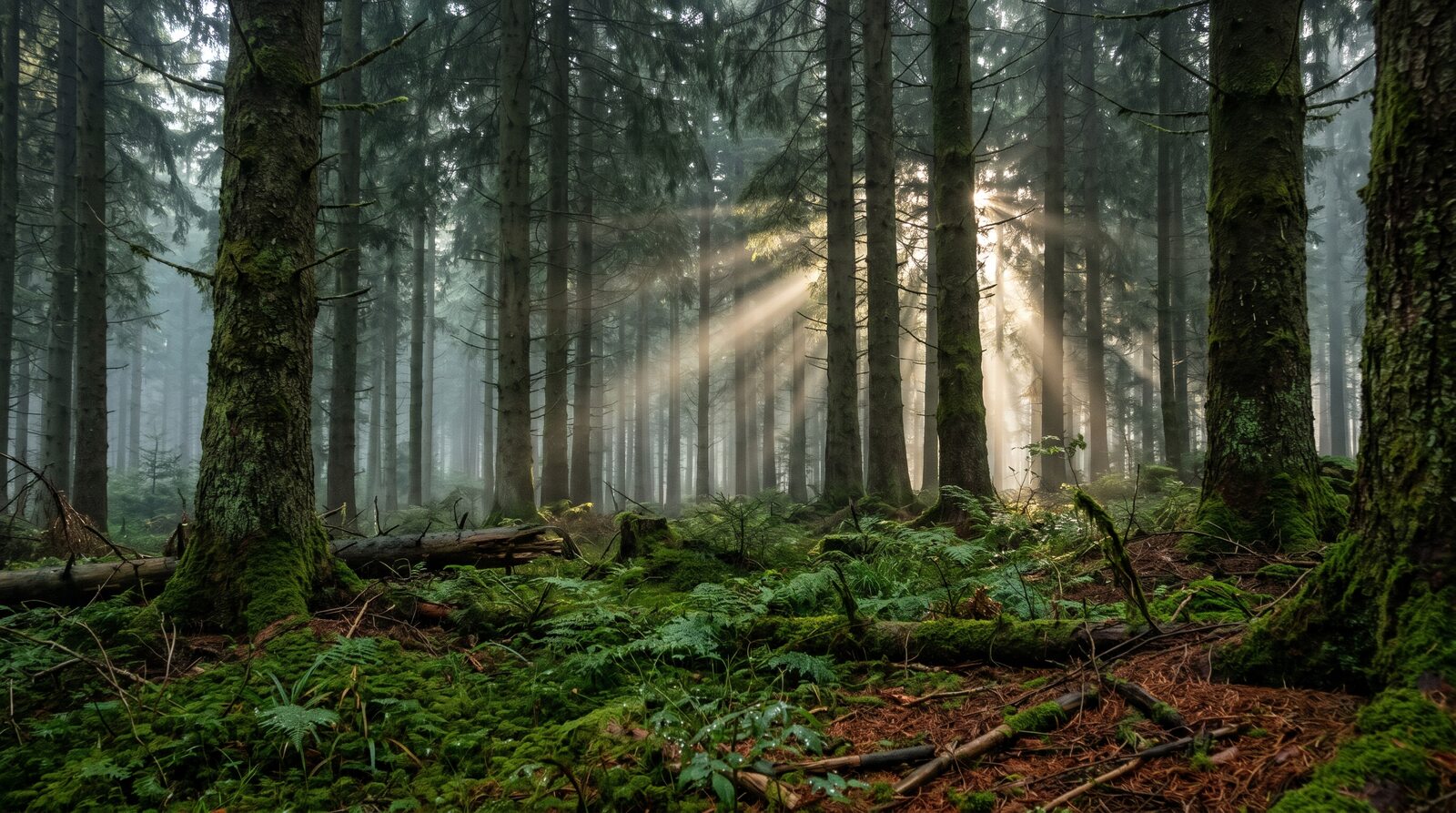

What is forest bathing?
A forest bath, known in Japanese as Shinrin-yoku (森林浴), literally “taking in the atmosphere of the forest”, is a well-being practice aimed at connecting consciously with nature through the five senses. It emerged in Japan in the 1980s, promoted by the Japanese Forestry Agency as a preventive public health initiative to counter work exhaustion (karoshi) and the stress of rapid technological and urban growth.
Physiological mechanisms and the science behind it
Several clinical studies, led among others by Dr. Qing Li and Nippon Medical School, have analyzed the biological effects of this practice.
Phytoncides: volatile organic compounds (mainly terpenes) that trees, especially conifers such as pines, cedars and firs, release into the air to defend themselves against insects, fungi and bacteria. When inhaled by people, they are associated with an increase in the activity and number of NK (Natural Killer) cells, key components of the immune system.
Autonomic nervous system modulation: it reduces the activity of the sympathetic system (responsible for the “fight or flight” response) and stimulates the parasympathetic system, which supports rest, digestion and physical recovery.
Stress biomarker reduction: significant drops in salivary cortisol levels have been documented, along with a stabilization of blood pressure and heart rate variability.
Attention restoration: based on Attention Restoration Theory (ART), natural visual patterns reduce the cognitive fatigue caused by prolonged concentration on screens and directed tasks.
How a session works
A forest bathing session follows a few simple guidelines, all of them designed to slow the pace down.
Digital disconnection: keep electronic devices switched off or in airplane mode to avoid interruptions.
A slow pace: move without hurry, stopping often to contemplate, sit or lie down.
Opening the senses: notice aromas, textures, the temperature differences between sunny and shaded spots, and the nuances of the soundscape.
Conscious breathing: take deep, slow diaphragmatic breaths, drawing in the fresh air of the undergrowth.
The guide’s role: facilitating, not lecturing
A forest bathing guide acts as a facilitator of the experience, not as a botany teacher or a hiking instructor. Their main function is to open a structured space that allows participants to slow their mental pace, switch off the everyday productive mode and connect with the natural environment through guided sensory dynamics.
Why it pays to have a guide
Although anyone can walk alone through the woods, most people tend to reproduce the same mental patterns of the city in nature: walking fast, chasing a physical destination (a summit, a viewpoint), checking the clock or the phone, or turning the walk into a continuous chat about work or daily worries. A guide is key for several reasons. So before booking a session, it is worth checking the guide’s training and experience. If you are considering training in this field, you can start by looking into a nature connection program.
They remove the mental load and the navigation: with no need to worry about the map, the time available, the orientation or the way back, participants can let go of the logistics entirely and give themselves over to the experience.
They overcome the “block” of slowing down: for a mind used to digital overstimulation, sitting in silence next to a tree for fifteen minutes can trigger initial restlessness or boredom. The invitations paced by the guide offer a clear focus that channels attention without demanding analytical effort.
They filter out the tendency to intellectual analysis: the guide deliberately avoids encyclopedic explanations (scientific names of species, geology, local history) so the brain does not activate analytical or discursive thinking, keeping attention on the purely sensory and physiological plane.
Safety and emotional containment: in states of deep relaxation and prolonged silence in nature, held-back emotions or moments of vulnerability can surface. The guide is trained in first aid in natural environments and in holding a safe, respectful space for the group.
What a guide actually does during a session
They design and select the route: they choose trails of low physical difficulty, away from artificial noise, with gentle slopes and high plant density (often with a notable presence of phytoncide-emitting trees such as conifers, oaks or beeches), checking safety and weather conditions beforehand.
They set and hold the pace: they impose a deliberately slow walking cadence (often less than one kilometer per hour) and schedule strategic stops to prevent the group from falling into the usual inertia of speeding up or treating the activity as physical exercise.
They propose sensory “invitations”: instead of giving orders or theoretical explanations, they suggest short, open activities of between ten and twenty minutes aimed at focusing the senses. For example: following with the eyes the movement of shadows and light cast by the forest canopy (komorebi); exploring with closed eyes the textures of rocks, bark, moss or soil; identifying the farthest and the nearest sound in the soundscape; or picking up a small sample of damp leaf litter to perceive the aromas of the undergrowth.
They facilitate sharing circles: after each invitation, they gather the group in a circle so that anyone who wishes can briefly express what they experienced, without debates, judgments or psychological interpretations, validating each participant’s experience.
Closing and integration: the session usually ends with a short tea ceremony, often prepared with safe aromatic plants from the surroundings or local infusions, and a small snack to ease the transition back to urban life.